Effective Use of Agentic AI Depends on Strategic Deployment in Customer Interactions
The deployment of agentic AI systems in customer service can significantly impact a company's reputation and efficiency. A framework categorizes the proximity of AI interactions with customers, highlighting the importance of placing AI in low-risk areas to avoid damaging customer trust and ensuring operational success.
In April 2025, an AI agent named 'Sam' at Cursor mistakenly informed users about a non-existent policy, leading to customer complaints and trust issues for the company. This incident illustrates the risks of deploying agentic AI in inappropriate contexts, emphasizing the need for careful consideration of where these systems are implemented in the customer journey.
A proximity framework categorizes AI deployments into three types: direct, mediated, and background. Direct proximity involves customer interaction with AI agents, which can lead to immediate visibility of failures. Mediated proximity includes AI working alongside humans, often without customer awareness, while background proximity operates entirely out of sight, focusing on operational tasks that do not directly affect customer relationships.
Successful deployments, like C.H. Robinson's background AI system, demonstrate that invisible AI can enhance efficiency without risking customer trust. Conversely, poorly placed AI can lead to increased complaints and reputational damage, highlighting the importance of strategic deployment in low emotional vulnerability areas.
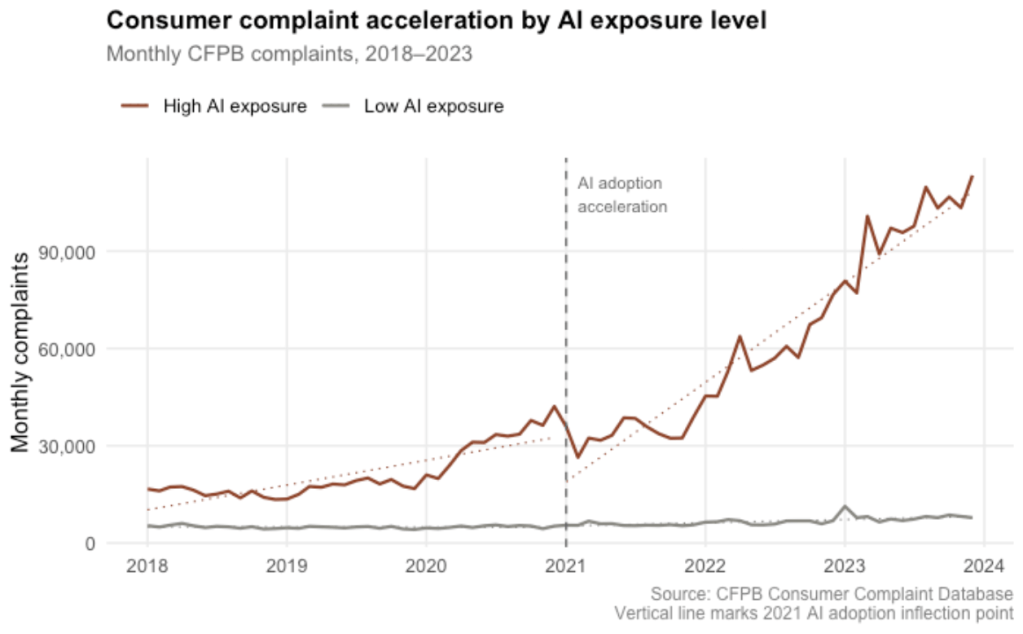
The 2025 National Customer Rage Survey indicated that 88% of e-commerce customers who interacted with AI had unfavorable experiences. Complaints to the Consumer Financial Protection Bureau doubled after the launch of ChatGPT, particularly among high-exposure firms, underscoring the financial and reputational risks associated with mismanaged AI interactions.
The framework suggests that background deployments yield the most consistent ROI with minimal risk, while direct deployments, though potentially beneficial, carry the highest risk of damaging customer relationships. Companies must balance the placement of AI systems with the emotional vulnerability of customers to maximize effectiveness and minimize negative outcomes.