AI Ethics
Oct 30, 2026
Goldman Sachs Reports Long-Term Effects of AI Job Displacement on Workers
Oct 30, 2026
AI Summary
Goldman Sachs has analyzed the impact of AI-related job losses, revealing that displaced workers are experiencing longer unemployment durations and lower earnings compared to previous technological disruptions. The study highlights significant challenges for older workers and suggests that younger workers may adapt more effectively to these changes.
- Goldman Sachs has tracked job displacement due to technology over the past 40 years, noting that AI-related layoffs are beginning to show similar long-lasting effects on workers as seen in previous technological shifts.
- Workers displaced from AI-exposed jobs since 2025 are taking about a month longer to find new employment and are more likely to remain unemployed after a year compared to other displaced workers.
- Older workers, particularly those aged 35 and above, face greater challenges in re-entering the workforce, taking about five weeks longer to find full-time work than their younger counterparts.
- The Labor Department reported an increase in job displacement, with 7.4 million workers affected from 2023 to 2025, up from 6.3 million in the previous survey.
- AI has been cited as a reason for 120,136 job cuts, making up about 21% of all layoffs announced through September.
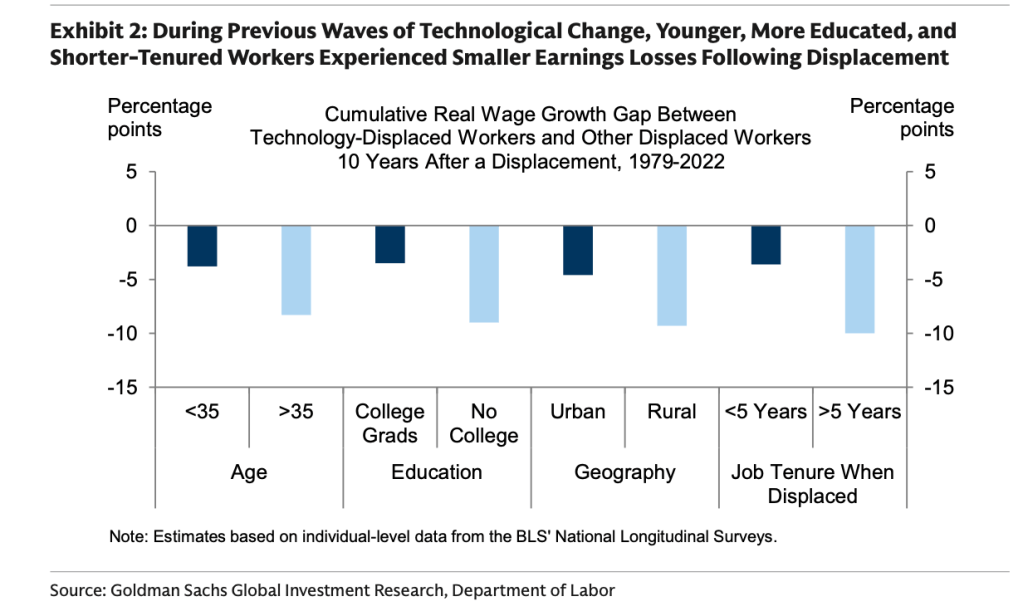
- Historical data shows that workers who lost jobs to technology tend to experience slower earnings growth and higher chances of future unemployment.
- Among long-tenured workers who regained full-time employment, only 49% earned as much or more than before, a decrease from 62% in earlier surveys.
- Younger, college-educated workers are experiencing less severe earnings losses compared to older workers, and they are more likely to adapt to AI disruptions.
- Research indicates that young workers in AI-exposed occupations are facing significant employment challenges, with job levels about 19% lower than those in less-exposed fields.
- Goldman’s analysis is based on data from the Current Population Survey’s Displaced Worker Supplement, focusing on over 15,000 displaced workers from 2016 to 2025, specifically capturing the first wave of AI-related job losses.
- The study suggests that AI-displaced workers are increasingly moving into roles with similar or higher AI exposure, reflecting a pattern seen in past technological disruptions.
ai layoffsjob marketworkforce impactage discriminationeconomic effects